

Cultivating a Deeper Connection With Our Bodies
/As our world presents us with increasingly complex challenges, let us explore a deeper relationship with our bodies and their connection to our lives.
Is it a fluke where in our body we injure ourselves or have aches and pains? Is there anything we can do to address this before it worsens?
Many years ago, while practicing yoga, I realized that there is a relationship between the flexibility in my body and the flexibility in my life–or the lack thereof, as the case may be!
Here’s another clue: One of my offerings is to lead shamanic drum journeys to help people discover what lies at the core of their illness, lostness, or dis-ease. A friend from Louisiana was visiting, and she asked me to lead a drum journey for her. She had a recent diagnosis of early-stage dementia. During the journey, she was shown painful memories from her youth that she had been trying to forget. Clearly, there is a relationship between dementia and wanting to forget certain things.
Painful events leave their marks, not just in our emotions, but also in our bodies.
More and more studies and disciplines are shedding light on this phenomenon and offering different approaches to healing.
I learned an approach in the early 1980’s through a program called "Body-Mind Clearing," based on an ancient Indigenous practice. The Indigenous group were known as fearless warriors because they worked to clear each other’s fear, tension, and trauma after their battles, so that the next day they could go into their next battle fearlessly.
We may not have battles in the same way these warriors did, but it seems we can’t avoid battle scars from just living our lives. However, there is no need for us to carry these scars for years. Wouldn’t it be amazing if we knew how to clear these battle scars promptly? It would be like a daily rebirth.
I’ll share an easily accessible approach that you can try at home.
What Body-Mind Clearing teaches is that we injure ourselves or develop pain or aches in the parts of our body where we hold fear, tension, or trauma. By way of a theoretical example, if you and I were walking together, and both of us slipped on a sheet of ice, I might injure myself in a different area of my body than you, depending on where we each hold fear, tension or trauma.
In that system, each body part is a metaphor for the different types of fear, tension or trauma we may hold:
We hold fear of guilt in our neck.
Fearing we are inadequate with responsibility is held in our shoulders.
Fearing that we lack ability is held in our backs.
Our legs hold issues with support. The backs of our legs hold support issues from the past. The front of our legs holds support issues for where we are headed.
Our knees have to do with fear issues around delegation.
Our ankles hold fears that cause us to hesitate.
Could we avoid more serious illness if we cleared our “battle scars” as we went along in life? Wouldn’t it be helpful if we remembered and applied the wisdom of the ancient ones?
How can we potentially clear these issues?
Here is the Body-Mind Clearing method for clearing affected areas of the body. Ideally, we would have a buddy to help us (for some parts of our bodies, it may be required, depending on how accessible the sore spot is). Sometimes, sore spots are only accessed through touch. Whether you're working on your own body or a buddy is helping you, both the patient and the practitioner have jobs to do.
Here are the steps.
The first step is for the patient to identify the metaphorical issue held in their body. For this, refer to the points above for guidance. If the points above don’t feel applicable, or if the affected area of the body isn’t listed above, see if you can figure out what the body part is telling you. Louise Hay has an internationally bestselling book with a wide range of suggestions and helpful tips. It is titled, “You Can Heal Your Life,” and is available as a free PDF download.
You can try asking the affected body part with a type of prayer conversation:
Always begin by thanking the affected body part.
Explain to this body part how you feel about it being sore/injured.
Ask the affected area to show you what it wants you to understand about this and what guidance it has for you, so you don’t repeat the pattern.
Listen & write down what comes to you.
Say thank you!
To the best of your ability, do what your body part suggests.
Here’s an example of a prayer conversation with a body part:
Dear (address your body part), thank you for (what the gifts are that this body part has offered to you). I’m sorry that you are swollen and sore (or whatever the case may be). I love and appreciate you, and I am ready to resolve this pain/ache/tension/whatever. Please show me what I need to understand so I can begin clearing this and resolving this pain/discomfort. Thank you.
Once you have a sense of the issue, develop an affirmation tailored to support that body part’s health. For example, if your shoulder is holding the issue, choose an affirmation that suits you regarding responsibility.
As a side note, I am not generally a fan of affirmations, but these are targeted to the relevant area of our body and seem to work.
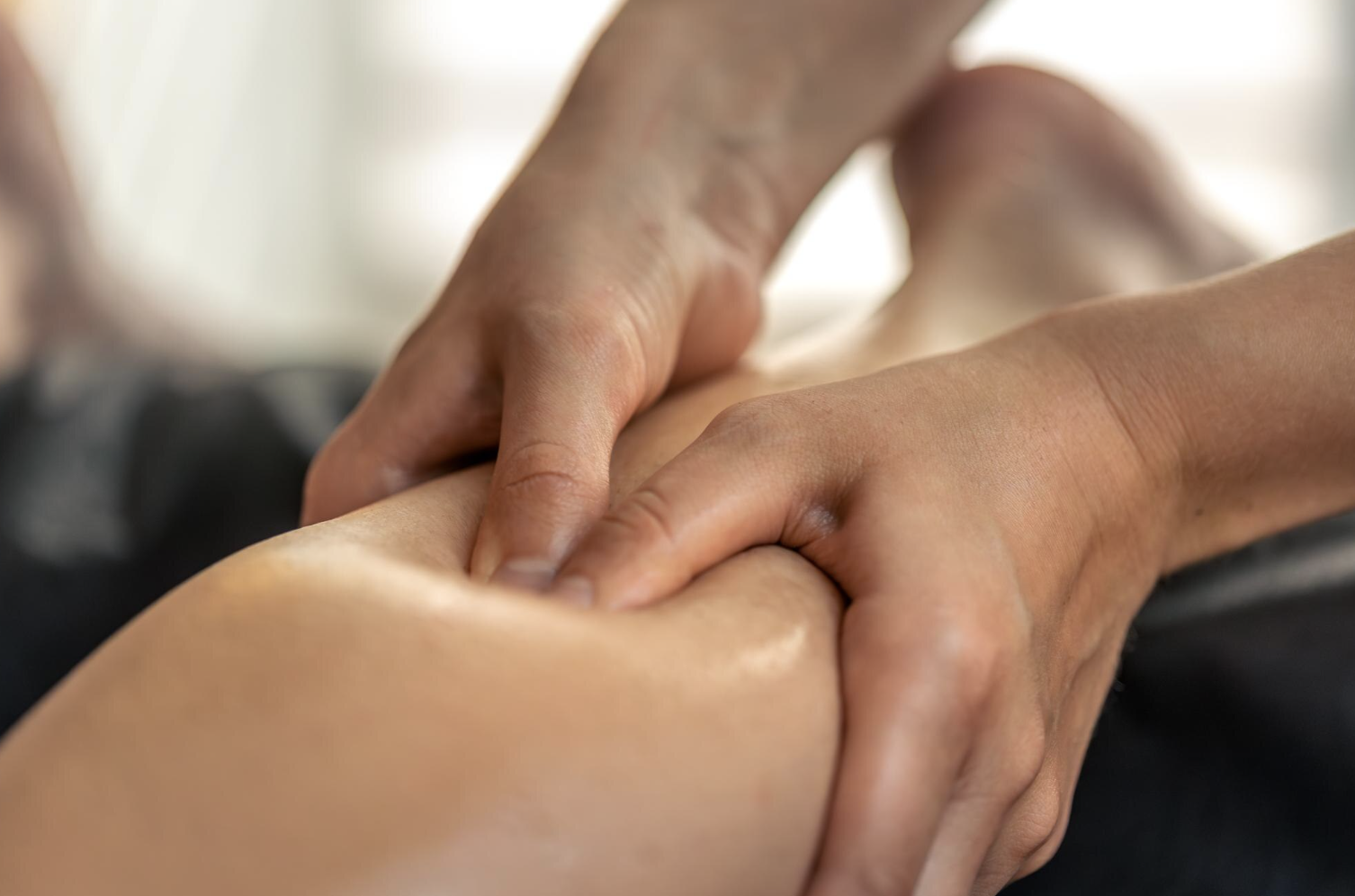
You are now ready for the three-part therapy. The person experiencing pain (the patient) lies on a yoga mat or blanket, with a pillow as needed for comfort. The supporting person (practitioner) identifies the sore spot on the other person by gently pressing into the affected area and asking for feedback on the location of the ‘hot spot’. For example, “Do you feel sensation here?” Once a hot spot is determined, there are three simultaneous moves:
The practitioner gently presses a finger, thumb, or elbow into the sore spot only until the patient feels slight discomfort. Hold there until the patient says it is okay to go a little deeper; i.e. when the pain goes away at that level. At times, the practitioner will naturally go deeper as the tension held in that spot releases.
While this is happening, the patient slowly moves the affected muscle, pausing slightly between each extension and relaxation, and continues to repeat their affirmation. For example, shrugging the shoulders and relaxing.
When the practitioner feels a release in the muscle or tendon, they apply slightly more pressure. Always check with the patient to make sure you are not going too deeply. The sensation should never be too much. Continue in this way, gradually increasing the pressure, until the pain or discomfort is gone.
Every small step you take towards understanding your body is a powerful act of self-love.
I wish you blessings with this connection and relationship with your body!
